Welcome to the Kluane Ridge Sundial

A sundial is an instrument that indicates the time of the day and the time of the year based on the position of the Sun in the sky.
There are two parts of a sundial. See Figure 1.

Figure 1. Parts of a Sundial
Not all hour lines are labelled on the Kluane Ridge sundial. This was done to avoid cluttering the sundial face.
Determine solar time
When sunlight strikes the gnomon, a shadow is cast on the dial face. In Figure 2, the time indicated is 11:40 AM. This is ‘solar time’ and for most of the year it differs slightly from the time indicated on a watch. The difference will be explained shortly, along with the corrections to accurately determine watch time.
Note that the time indicated on a sundial is formally referred to as ‘apparent solar time’ and the time reported on a watch or clock as ‘mean solar time. For simplicity in this article, we will refer to solar time (sundial time) and watch time.
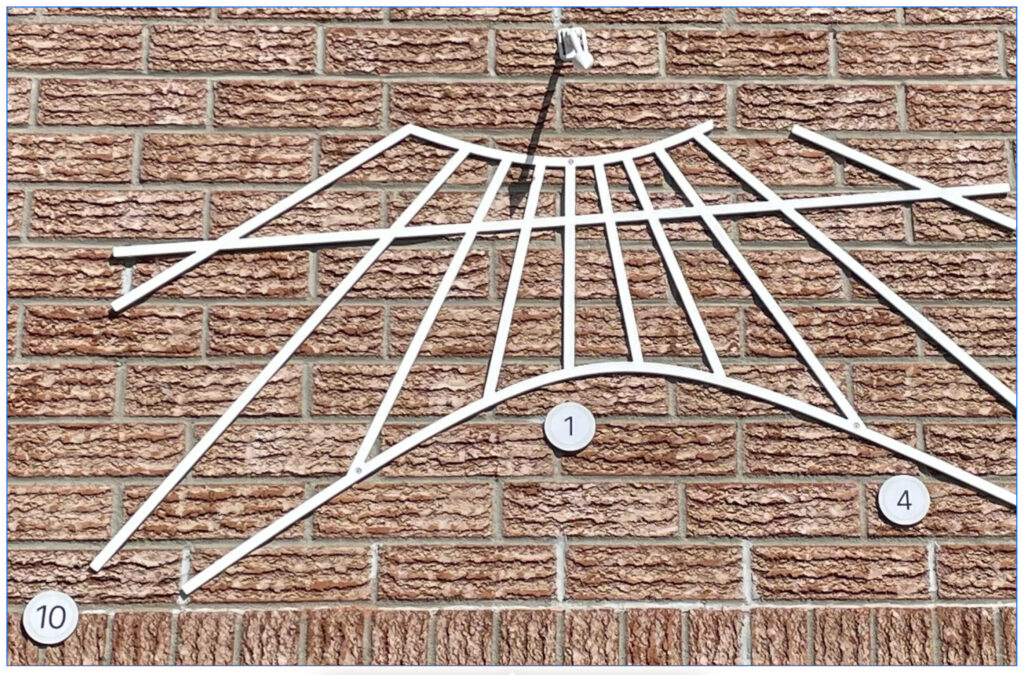
Figure 2. Gnomon casting a shadow on dial face. This photo was taken on March 14th.
Determine time of year
The length of the gnomon shadow varies throughout the year. When the Sun is lowest in the sky (Winter solstice = Dec 21), a short shadow is cast to the top curved line.
On the Summer solstice (June 21), the Sun is highest in the sky and the gnomon shadow is the longest and extends to the bottom (summer solstice) line.
The middle line that is straight and slopes up to the right is the Equinox line. On the Equinox, the duration of daylight matches the duration of nighttime. There are two equinoxes: the Vernal or Spring equinox (March 21) and the Autumnal equinox (Sept 21). On these days, the tip of the gnomon shadow will travel across the sundial equinox line.
The photo in Figure 2 was taken on March 14th when the shadow was close to the equinox line.
Here is a video that shows the gnomon shadow moving during the daytime on the Vernal equinox. The shadow follows the same path on the Autumnal equinox.
Video 1. A time-lapse series of images showing the gnomon shadow move across the sundial over the course of a day.
Let’s consider a day. On a watch or a clock, a day is 24 hrs long. It is fixed in duration. It is based on the 24 hour time standard known as Universal Coordinated Time (UTC).
In contrast, a solar day can vary in duration throughout the year. Some solar days are slightly longer than 24 hours (by at most 29 sec), while others can be shorter (by up to 22 secs). The daily differences accumulate over the course of a year and can range from +16 minutes to -14 minutes, depending on the time of the year. These differences account for the discrepancy between the time reported by a sundial and a watch.
The reasons for this difference will be explained in a later section.
The difference between clock time and solar time throughout the year are reported in something called the “Equation of Time” (EoT). The EoT is typically expressed as a graph (Fig 3) or a table.
Watch time is determined by applying the adjustment (the difference) to the time reported on the sundial. Again, the adjustment varies according to the day of the year, as illustrated in the following chart.
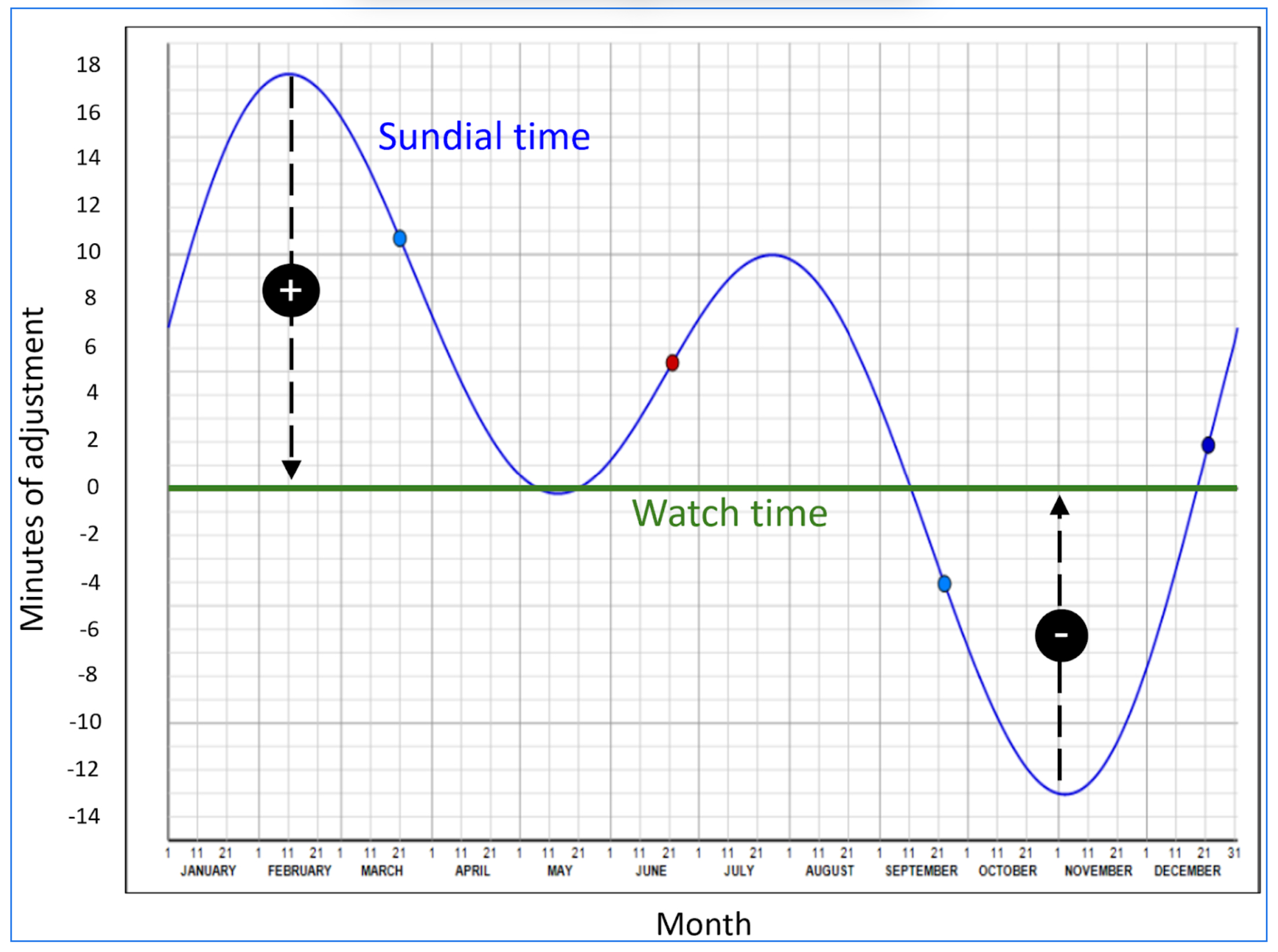
Figure 3. Graph of time adjustments for the Kluane Ridge Sundial. Watch time is determined by applying the time adjustment to the observed sundial time.
For example, let’s assume today is March 21. The adjustment noted in the chart for March 21 is approximately 11 minutes (see blue dot on the left side of the EoT graph). If the time indicated on the sundial is 10:30 am, the watch time is calculated to be 10:41 am (10:30 + 11 minutes).
There are times during the year when there are negative corrections (Oct and Nov). There are also times when no correction is required. One example is on September 11. On this day, the solar time reported by the Kluane Ridge Sundial matches the time reported on a watch.
Sundials typically have other time corrections that have to be applied to determine watch time. For example, longitude correction and Daylight saving time correction. The Kluane Ridge sundial was designed to incorporate these corrections.
There are two factors that influence the length of the solar day:
Influence of Earth’s elliptical orbit on duration of solar day
Due to the elliptical orbit, the distance of the Earth from the Sun varies throughout the year. When the Earth is closest to the Sun (Jan 2), it moves fastest in its orbit. When it is furthest from the Sun (July 4), it moves the slowest.
To understand how the speed of the Earth in its orbit influences the length of the solar day refer to Figure 4.

Figure 4. Illustration of how a solar day is influenced by the revolution of the Earth around the Sun.
Before explaining this Figure, it is important to note that a solar day is defined as the time between two consecutive solar noons when the Sun is at its highest point in the sky.
Contrary to popular belief, the Earth does not rotate exactly 360 degrees in 24 hours. Instead, it completes one full rotation (360 degrees) in 23 hours, 56 minutes, and 4 seconds – this is called a sidereal day. This is illustrated in Figure 4 with the Earth in 3 positions as it revolves around the Sun.
In summary, as Earth orbits the Sun it must rotate slightly beyond 360 degrees for the Sun to return to its highest position in the daytime sky. The additional rotation required depends on Earth’s orbital speed:
Influence of Earth’s axial tilt on the duration of solar day
Additionally, Earth’s axial tilt affects the Sun’s apparent motion in the daytime sky. The Sun moves both north-south (higher-lower) in the sky and east-west in the sky. When its north-south motion is significant, its east-west movement slows, and vice versa. Since timekeeping depends on east-west movement, these variations contribute to changes in the length of a solar day.
The solstice lines have the shape of hyperbolas. An excellent visual explanation is presented in this YouTube video by Zach Star.
These asymmetries arise from the fact that the sundial does not face exactly south. It faces 5 degrees west of south. In the language of sundial enthusiasts, it ‘declines’ 5 degrees west of south.
This is how the Kluane Ridge Sundial would appear if it were oriented directly south. It is symmetrical about the 12 o’clock vertical line.

Figure 5. Depiction of Kluane Ridge sundial if it faced due South. Note the left-right symmetry and vertical gnomon.
This is how the Kluane Ridge Sundial would appear if it were oriented 45 degrees west of South:

Figure 6. Depiction of Kluane Ridge sundial if it faced 45 degrees west of South.
This is how the Kluane Ridge Sundial would appear if it were oriented 45 degrees east of South:

Figure 7. Depiction of Kluane Ridge sundial if it faced 45 degrees east of South.
As previously noted, the Earth moves at varying speeds along its elliptical orbit around the Sun. It travels slowest when it is farthest from the Sun, which coincides with the time of year when the northern hemisphere is tilted toward the Sun (summer in the northern hemisphere). During this period, the Sun is positioned north of the Earth’s equator. Because the Earth moves more slowly at this point in its orbit, the Sun remains north of the equator for approximately three more days compared to when it is south of the equator. This means summer is slightly longer in the northern hemisphere.
The calendar design accounts for this difference, because there are 184 days between March 21 and September 21, and 181 days between September 21 and March 21 of the following year.
There are many excellent resources on the Internet on sundials. The North American Sundial Society and the British Sundial Society have excellent websites with many educational resources.
***